


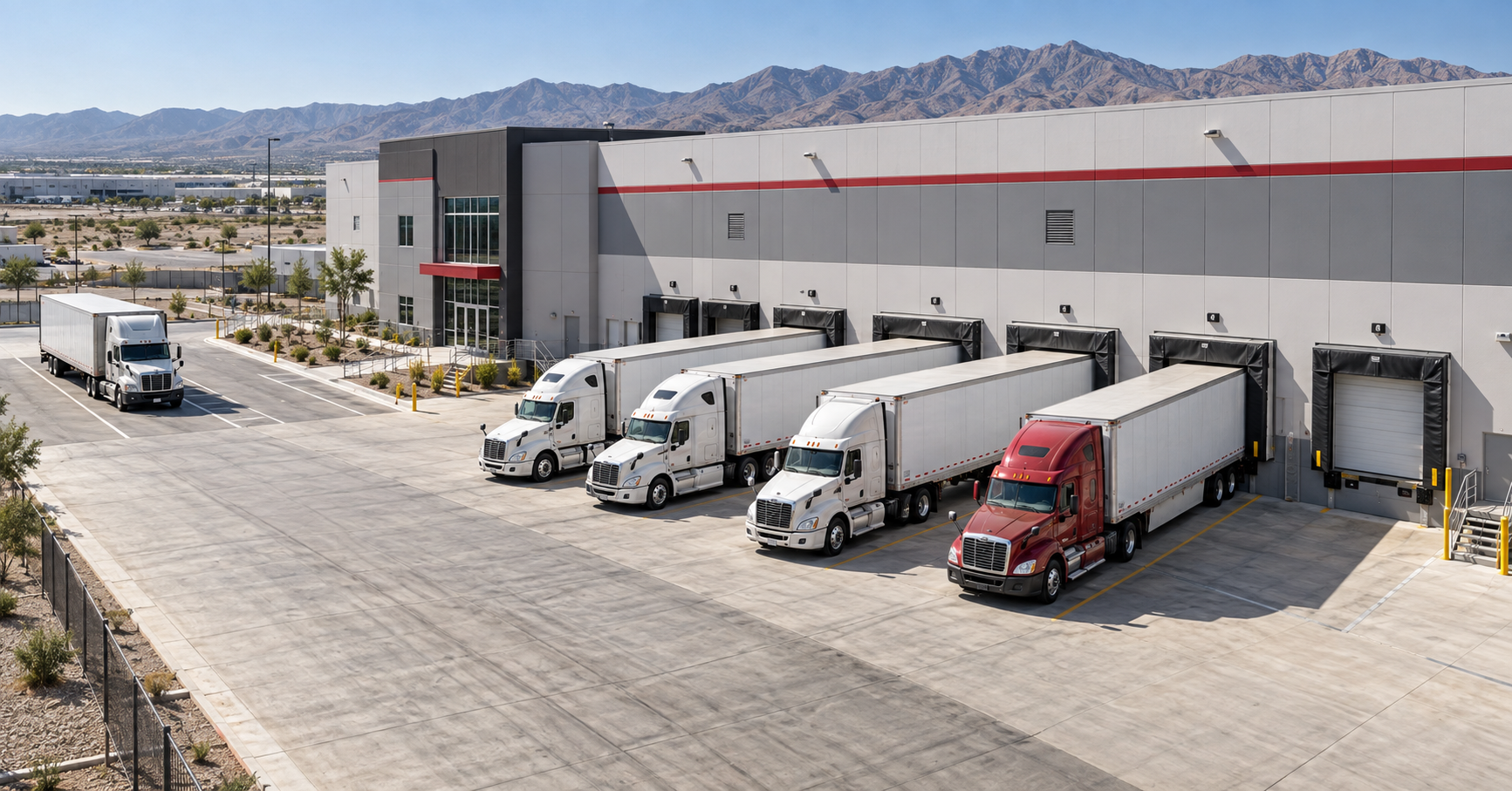
How tenants can assess capacity, understand congestion, and decide when more docks are needed.
1. Are your loading docks becoming a bottleneck?
It is 9:00 a.m., and every loading dock is occupied. Two trucks are waiting in the yard. Another is approaching the gate. Inside, your team is trying to finish unloading an inbound shipment so an outbound truck can take its place.
By 3:00 p.m., several docks are empty.
Does your warehouse have too few loading docks?
Both observations can be true: the building may have enough capacity across the day but struggle to provide it during the hours your operation needs it most.
For a tenant, that distinction matters. Additional docks could relieve a recurring constraint. They could also add expense while leaving the real cause of delays unresolved.
A loading dock becomes a bottleneck when demand for its use exceeds what it can handle during a particular period, causing work to wait. An occasional queue is not necessarily a problem. Trucks may wait briefly and still depart on time. The concern is a pattern that affects performance:
- Trucks regularly wait longer than your operation considers acceptable.
- Shipments depart late because a suitable dock is unavailable.
- Receiving and shipping compete for the same doors.
- Overtime becomes necessary to clear delayed work.
- One late truck or unavailable dock disrupts several later appointments.
These are reasons to investigate, not proof that you need another building.
Imagine two warehouses, each with five docks and three trucks waiting outside. At the first, all five docks are occupied and loading and unloading are progressing normally. At the second, two suitable docks are empty because no forklift operators are available.
The visible symptom is the same. The solution is different.
Before considering expansion or relocation, establish what prevents the waiting truck from moving forward.
The central question is: Can your current docks handle your busiest periods with acceptable waiting times and reliable departures, including ordinary disruptions?
2. What determines how much your docks can handle?
Three factors provide the foundation for your assessment: usable docks, dock time, and arrival patterns.
Usable docks
Count the doors suitable and available for the truck activity you are assessing.
A door may be unavailable because equipment is damaged, access is blocked, or it cannot accommodate the arriving truck. If two of six docks are dedicated to shipping and cannot serve receiving, receiving has four usable docks.
Then check whether staff and equipment can support simultaneous work at those doors. Five physical positions do not guarantee that five trucks can be loaded or unloaded at once.
The surrounding layout matters too. Vehicle approach, dock configuration, and interior staging all contribute to a functioning operation. Rite-Hite dock-design guidance.
Dock time
For this article, dock time is the full period from calling a truck forward to a reserved dock until that dock becomes available again. This definition counts the time the position is committed to that truck, including maneuvering.
Use these terms consistently:
| Term | Meaning |
|---|---|
| Waiting time | From readiness for service until the truck is called forward to a dock |
| Maneuver time | From being called forward until the truck is positioned and secured |
| Service time | From the start to the finish of loading or unloading, including interruptions during that work |
| Clearance time | From the end of loading or unloading until the dock is available again |
| On-time departure | Whether the truck leaves the facility by its agreed departure time |
Dock time includes maneuver time, service time, clearance time, and any delay between positioning and the start of service.
For example, a truck requires 10 minutes to maneuver, waits five minutes before service, takes 35 minutes to load, and needs 10 minutes to clear the dock. Its dock time is 60 minutes, although loading takes only 35 minutes.
Waiting time before being called forward is separate. Arrival and readiness are also different events: a truck might arrive at 8:00, complete check-in at 8:15, and be called forward at 8:30. Its waiting time after readiness is 15 minutes.
Agree on how early arrivals will be treated; a truck arriving before its appointment should not automatically be classified as a capacity-related delay.
Arrival patterns
Daily volume tells you how much work must be handled. Arrival timing tells you when capacity is needed.
Eight trucks spread across several hours place different demands on a warehouse than eight trucks arriving together.
That is why your assessment must examine peak windows: the busiest periods of the operation. A full-day average can conceal an overloaded morning followed by a quiet afternoon.
Predictability matters too. Reliable appointments and consistent dock times make scheduling easier. Late arrivals and variable dock times make it harder to know when the next position will become available.
3. Predictable flow: does your schedule fit your dock capacity?
When trucks generally arrive as scheduled and dock times are reasonably consistent, use a capacity calculation followed by an appointment-overlap check.
Calculate available and required dock-hours
Choose a peak window—for example, 8:00–10:00 a.m.
One dock-hour means one dock available or required for one hour.
Available dock-hours = usable docks × hours in the peak window
With five usable docks across two hours:
5 × 2 = 10 available dock-hours
Next, add up the dock time required within that window. Eight trucks needing one hour each require eight dock-hours.
Planned dock utilization = required dock-hours ÷ available dock-hours × 100
For this example:
8 ÷ 10 × 100 = 80%
| Measure | Result |
|---|---|
| Usable docks | 5 |
| Peak window | 2 hours |
| Available capacity | 10 dock-hours |
| Required dock time | 8 dock-hours |
| Planned dock utilization | 80% |
If truck visits have different durations, add their individual expected dock times. Include work already using docks when the window starts. For visits crossing the window boundary, count only the portion inside the window and check the remaining work in the neighboring period.
Check when the appointments overlap
Assume all five docks can handle these trucks, adequate staff and equipment are available, there is no earlier backlog, and each truck needs exactly one hour of dock time—including maneuvering and clearance.
Four trucks ready at 8:00 and four at 9:00 produce this schedule:
| Period | Docks required | Usable docks | Docks left available |
|---|---|---|---|
| 8:00–9:00 | 4 | 5 | 1 |
| 9:00–10:00 | 4 | 5 | 1 |
The work fits, and one dock remains available throughout.
Now schedule all eight trucks for 8:00. Five can begin immediately; three wait an hour. All work still finishes by 10:00, and utilization remains 80%.
The calculation checks whether the total work fits. The schedule checks whether capacity is available at the right time.
Treat 80% as a planning reference
In this article, 80% is an illustrative screening reference, not an industry-wide pass mark. Below it does not guarantee short waits; above it does not automatically mean the building is inadequate.
The margin needed depends on variability, the number of service positions, and the waiting performance required. Research on systems with multiple service positions supports this relationship. Ward Whitt, Understanding the Efficiency of Multi-Server Service Systems.
If the workload fits but appointment overlap creates waits, investigate rescheduling. If required dock time repeatedly exceeds available capacity in periods that cannot be shifted, you have evidence of a capacity shortfall.
4. Unpredictable flow: what happens when trucks arrive together?
When arrival times or dock times vary significantly, the planned schedule may not reflect what happens on the ground.
Use historical records to examine dock occupancy, waiting time, and on-time departure.
Reconstruct your busy periods
Collect several representative weeks of arrival, readiness, call-forward, service, dock-clearance, and departure records. Record delay reasons as well. Include seasonal peaks before making a major property decision.
Organize the information into four groups:
- Arrival and readiness for service.
- Waiting time.
- Service time and dock activity, including maneuvering and clearance.
- Reasons for delays and departure results.
A spreadsheet can reconstruct when each dock was committed and when trucks were waiting.
For this assessment:
Dock occupancy = docks committed to trucks ÷ usable docks × 100
With five usable docks, four committed means 80% occupancy; five committed means 100%.
Full occupancy alone does not establish a problem. All docks may be working with no truck waiting. The question is whether another ready truck arrives before capacity becomes available.
Same warehouse, different arrivals
Keep the same five docks and eight trucks, each requiring one hour of dock time. Assume the same conditions as the scheduled example, with trucks served in the order they become ready.
This time, six trucks are ready at 8:00 and two more at 8:15.
| Time | What happens | Docks committed afterward | Trucks waiting |
|---|---|---|---|
| 8:00 | Six trucks are ready; five are called forward | 5 | 1 |
| 8:15 | Two additional trucks are ready | 5 | 3 |
| 9:00 | First five clear; remaining three are called forward | 3 | 0 |
| 10:00 | Remaining three clear their docks | 0 | 0 |
One truck waits 60 minutes. Two wait 45 minutes each.
The operation still completes eight dock-hours of work within ten available dock-hours: 80% utilization.
| Result | Four arrivals at 8:00 and four at 9:00 | Six arrivals at 8:00 and two at 8:15 |
|---|---|---|
| Trucks handled | 8 | 8 |
| Two-hour utilization | 80% | 80% |
| Trucks that wait | 0 | 3 |
| Longest waiting time | 0 minutes | 60 minutes |
These are hypothetical calculations, not industry averages. They show why utilization must be read alongside waiting.
Compare performance with your requirement
Suppose your business sets a target of calling at least 95% of ready trucks forward within 30 minutes. This is an illustrative management target, not a universal standard.
In the clustered example, only five of eight trucks meet it—62.5%.
Average waiting across all eight is 18.75 minutes, which can sound acceptable while concealing the three longer waits.
Review the percentage of trucks exceeding your limit, the longest waits, and whether delays contribute to late departures.
Look at busy periods individually rather than averaging all daily peaks into one number. Check how long full occupancy lasts and when the waiting queue clears.
In the example, the queue clears at 9:00, when the final three trucks are called forward. Dock work finishes at 10:00. Actual facility departure must be recorded separately.
A queue that repeatedly carries into the next busy period is stronger evidence of insufficient capacity than an isolated delay.
5. How to recognize insufficient dock capacity
Your assessment should distinguish three conditions:
| Condition | Evidence |
|---|---|
| Capacity appears sufficient | Representative busy periods meet waiting and departure requirements, and ordinary disruptions are absorbed |
| Spare capacity is limited | Normal schedules work, but modest disruptions repeatedly push performance beyond acceptable limits |
| Capacity is insufficient for the current operating pattern | Available docks cannot reliably handle required flow, and queues regularly disrupt later work or departures |
These are performance judgments, not fixed utilization bands.
Look for a recurring chain of evidence
The case for a genuine dock shortage becomes stronger when suitable docks are unavailable, that unavailability causes meaningful delays, and the pattern repeats under conditions the business must handle.
Those conditions can include regular weekly surges or seasonal peaks. They should not be dismissed simply because they do not occur every day.
Then determine why the docks remain committed for so long.
If trucks wait while suitable docks are empty, investigate staffing, equipment, assignment procedures, readiness, and yard access.
If docks remain committed, examine maneuver time, service time, clearance time, and delays between those activities. Some of that time may be reducible; some is necessary for the freight being handled.
Do not base a property decision on improvements that the operation cannot realistically sustain.
Test an ordinary disruption
Return to the predictable schedule: four trucks each hour, five docks, and one-hour dock time.
Losing one dock reduces two-hour capacity from ten dock-hours to eight. The same workload now uses 100% of available capacity.
The exact schedule still fits, but all four remaining docks are committed throughout both hours. A truck taking 20 minutes longer than expected may delay a later appointment.
Whether that is acceptable depends on your waiting target, departure commitments, and how often similar delays occur.
Also record overtime and emergency schedule changes. On-time departures can conceal pressure if they depend on repeated intervention. Confirm that dock unavailability is causing the extra work before attributing its cost to the building.
For growth planning, repeat the assessment with credible future truck volumes and arrival patterns. A projection is a planning scenario, not evidence that current capacity is already inadequate.
6. Do you need operational improvements—or a warehouse with more docks?
Match the response to the constraint you have identified.
| Main constraint | Response to evaluate |
|---|---|
| Concentrated arrivals | Stagger appointments or adjust receiving and shipping hours |
| Excessive maneuver time | Improve circulation, parking, and dock access |
| Delays before service | Prepare freight, documents, equipment, and crews earlier |
| Excessive service time | Review handling methods, staffing, equipment, and interruptions |
| Excessive clearance time | Improve release procedures and timely trailer removal |
| Insufficient usable docks after feasible improvements | Evaluate modifications, expansion, or relocation |
Carrier schedules, customer commitments, and operating restrictions may limit these options. Assess what is feasible rather than assuming every arrival can be moved or every delay eliminated.
Verify the capacity gained
Suppose a tested clearance improvement reduces dock time from 60 to 50 minutes for each of the eight trucks.
8 × 50 minutes = 400 minutes, or 6 hours and 40 minutes of required dock time.
Across ten available dock-hours, utilization falls from 80% to approximately 67%.
That reduces required capacity. It still does not allow all eight trucks to start simultaneously at five docks.
After making a change, compare waiting, dock time, queue clearance, and departures under similar busy conditions. A quieter week should not be mistaken for a successful improvement.
Assess what the current property can provide
If dock availability remains the constraint, investigate restoring unusable doors, sharing suitable docks between receiving and shipping, or adding positions.
Additional openings need adequate vehicle access, maneuvering room, staging, and equipment. Confirm physical feasibility, necessary approvals, landlord consent, and the effect of construction with the owner and qualified advisers.
If the existing building cannot meet the requirement, evaluate expansion or relocation.
Give your tenant representative an operating brief covering peak arrivals, dock time by truck type, waiting targets, departure commitments, sharing restrictions, staffing assumptions, and expected growth.
Test candidate buildings against that same brief. A building with eight doors is not automatically a better fit than one with six if its yard or staging limits simultaneous use.
For predictable flow, test appointment overlap. For variable flow, use representative historical arrivals and dock times to examine likely waiting. A detailed simulation may be appropriate when interactions are complex or the investment is substantial.
Compare the cost of operating reliably
Consider rent alongside staffing, additional shifts, equipment, modifications, moving costs, and transition disruption. Include documented costs of the present constraint, such as recurring overtime or carrier charges.
Keep measured costs separate from estimated savings.
Before choosing a warehouse with more docks, confirm that:
- The performance problem recurs during representative peak periods.
- Unavailable suitable docks are a demonstrated cause.
- Feasible operating improvements have been assessed.
- The current property’s modification or expansion options are understood.
- Alternative buildings have been evaluated against the same operating requirement.
The result is a requirement you can explain: how many trucks must be handled, when they arrive, how long they need a dock, and how much waiting the business can accept.
The right warehouse is one whose usable dock capacity supports that requirement reliably.
Evaluating whether your current warehouse still fits? Industrial de Tijuana helps tenants translate operating requirements into a property brief and compare options for renewal, expansion, or relocation.